

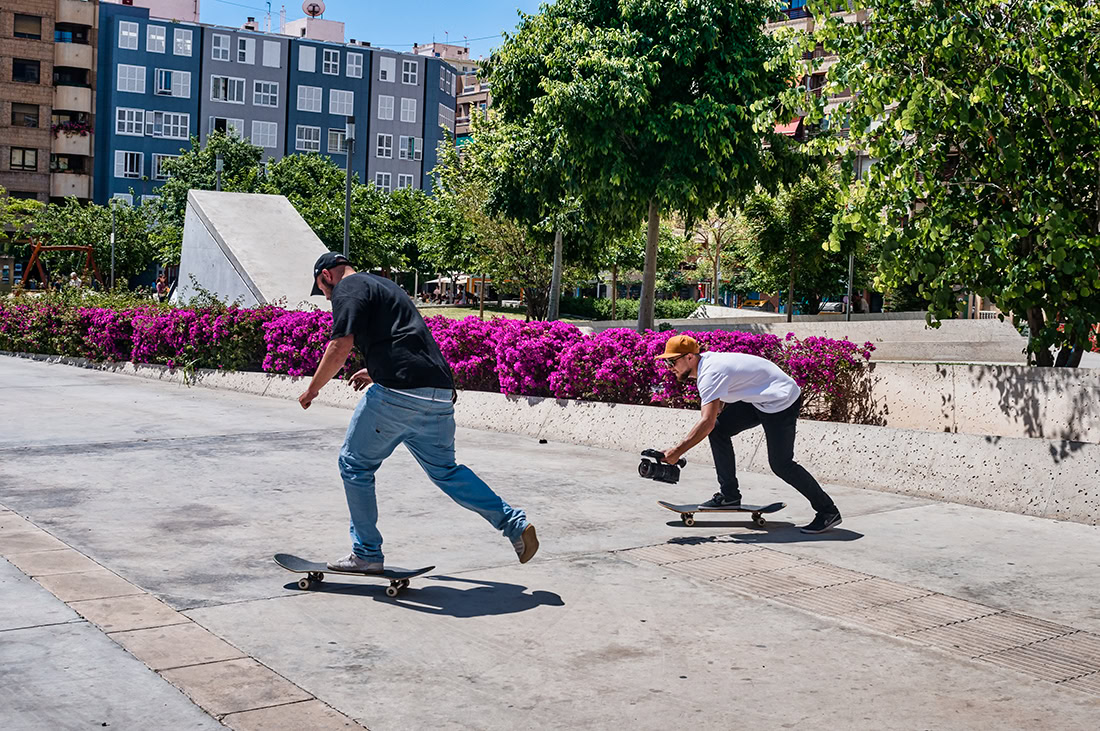
Javier M. Reguera. Everything I’ve seen in the world looks like you {Project}. 01Skate 2016-2019 *2025 {Serie}
For many skaters themselves, skateboarding is much more than merely a leisure pastime. It can justifiably be seen as a form of youth culture, in the sense that it has its own preferred modes of symbolic representation, its own aesthetic, its own ethical codes and rules and its own ideology. To be a skateboarder is to be more than just a person who happens to roll about the city streets on a piece of wood.
Being an accomplished skater, and knowing where and how to skate, is obviously part of the story; as is wearing particular clothes and accessories, having a particular hairstyle, listening to particular kinds of music, and choosing particular products or brands.
But the skilful use of these external markers also helps to define you as a member of a group that is presumed to share particular values, values that are to some degree defined in opposition to, or at least as an alternative to, those of mainstream adult society. Becoming a skater entails a process of self-identification: it is about the assertion of an attitude, and the claiming of an identity, that is literally embodied in particular forms of visual appearance and physical style.
David Buckingham. «Skate perception: self-representation, identity and visual style in a youth subculture», 2009